


Buitenveldert, Zuidas
Stadsdeel Zuid
Buitenveldert and the Zuidas form a dynamic area in the south of Amsterdam. Buitenveldert is a green, quiet residential area with many parks, including the Amsterdamse Bos, and modern amenities. The Zuidas is the city’s business district, known for its skyscrapers, international companies and legal institutions. The area combines living, working and recreation, and offers both quiet residential areas and a vibrant business center.
Population 29.285 (2024)
Stadsdeel Zuid consists of 3 areas:

Buitenveldert and Zuidas: Where Green Tranquility Meets Urban Ambition
In Amsterdam’s southern reaches, two worlds exist side by side. One offers peaceful gardens and family homes. The other pulses with international business and soaring towers. Together, Buitenveldert and the Zuidas create a unique urban tapestry. This area blends residential calm with economic energy.
From Polder to Garden City
Before the 1950s, Buitenveldert was nothing but farmland. The Binnendijksche Buitenveldertse polder stretched across the landscape. Market gardens dotted the fields. Cows grazed in meadows. Only one building stood here: Het Kalfje, a tavern along the Amstel River.
In 1921, Amsterdam annexed this rural polder. The city limits finally reached the Kalfjeslaan. Yet development remained decades away.
Everything changed with Amsterdam’s General Expansion Plan of 1935. Architect Cornelis van Eesteren envisioned a new suburb on the south side. Unlike the western garden cities, this would be Amsterdam’s sole southern expansion. The Second World War delayed construction. But hope remained.
In 1955, workers began transforming the polder. Sand arrived from Loosdrecht. The entire area rose meter by meter. Piles drove deep into the soft ground. In 1958, the first stone was laid. By 1959, the first families moved into their new homes.
Buitenveldert embodied garden city principles perfectly. Architects designed wide streets lined with trees. Parks punctuated the neighborhoods. Low-rise buildings alternated with taller apartment blocks. Green spaces connected everything together. The Gijsbrecht van Aemstelpark formed an ecological corridor. It stretched from the Amsterdamse Bos to the Amstel River.
The streets tell Buitenveldert’s story through names. Main avenues honor medieval bailiffs of Amstelland. Side streets celebrate Dutch provinces. Each provincial cluster features castles and country estates. This naming system creates a geographic tapestry across the neighborhood.
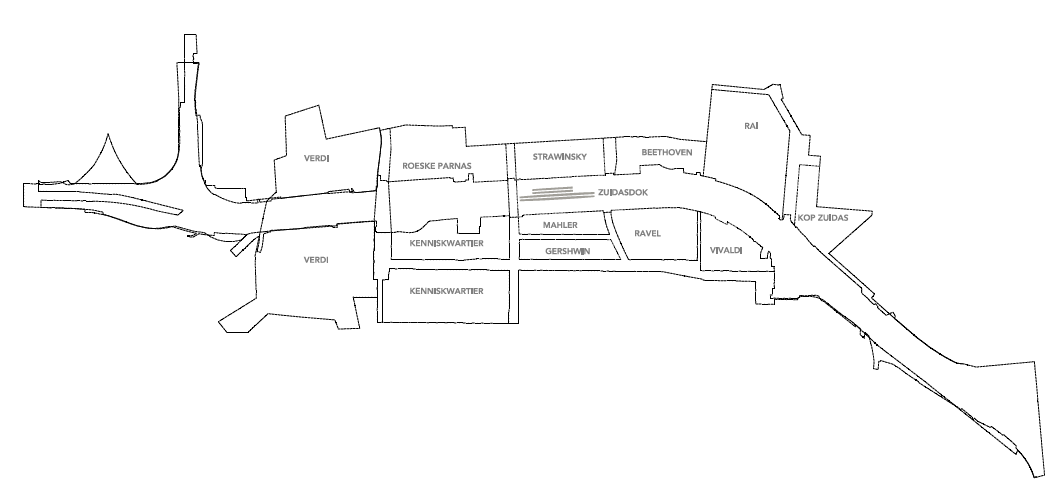
Sub-areas Amsterdam Zuidas
Birth of a Business District
While Buitenveldert grew residential, seeds of change were planted. The area between Prinses Irene and Buitenveldert featured a notable height difference. Two polders met here along a walking path. Before World War II, couples strolled this lovers’ lane. They gazed across gardens and countryside.
In the 1980s, Amsterdam sought a prime business location. The preference initially focused on the IJ riverbanks. But in the early 1990s, everything shifted. ABN AMRO bank made a pivotal decision. They chose to build headquarters near Amsterdam Zuid station. Proximity to Schiphol Airport proved irresistible.
The bank’s choice sparked Amsterdam’s vision. In 1998, the city council adopted the Zuidas master plan. The goal was ambitious: create a business district comparable to La Défense or Canary Wharf. However, this wouldn’t be pure commerce. The vision emphasized balance between living, working, and amenities.
The World Trade Center Amsterdam pioneered development. Established in 1985, it housed over 300 international firms. Between 1998 and 2004, major renovations expanded the complex. The Zuidas began taking shape.
High-rise buildings rose along the A10 ring road. Glass facades reflected Dutch skies. International companies arrived steadily. Google established operations here. AkzoNobel built headquarters. After Brexit, the European Medicines Agency relocated from London to Zuidas.
By 2005, floor space reached approximately 3 million square meters. Today, over 700 companies call Zuidas home. The district hosts more than 50,000 workers. International finance mingles with legal services. Educational institutions anchor the southern edge.
A Diverse and Dynamic Population
Buitenveldert houses a notably diverse community. The neighborhood is famous as Amsterdam’s modern Jewish quarter. Approximately half of the Netherlands’ 40,000 Jews live here and in adjacent Amstelveen.
Six synagogues serve the community. Three Jewish schools educate children. Kosher restaurants, bakeries, and shops line the streets. Jewish nursing homes provide eldercare. This vibrant community rebuilt itself after the Holocaust’s devastation. In 1945, only 5,000 Jews returned to Amsterdam. Today, the community numbers around 15,000.
The Jewish presence traces to the 1950s. Young families sought proximity to the old Jewish quarter. Buitenveldert offered something precious: houses with gardens near the city center. In 2008, Amsterdam established an eruv. This designated area allows observant Jews to carry objects on Shabbat. Weekend streets now fill with Orthodox families picnicking in parks.
Japanese residents form another significant community. Japanese schools, shops, and restaurants serve this population. The area reflects Amsterdam’s international character. Expatriates appreciate Buitenveldert’s proximity to Zuidas. Professionals working in the business district live nearby.
Amsterdam Zuid borough, encompassing both areas, houses almost 145,000 inhabitants. It ranks as Amsterdam’s most prosperous borough. Household incomes exceed other districts significantly. The area attracts educated professionals and international workers.
Zuidas itself hosts 5,300 residents. However, this number is growing rapidly. The 2016 vision planned for approximately 7,000 homes by 2030. The 40-40-20 rule guides new construction: 40% social housing, 40% mid-market, and 20% private sector. This ensures economic diversity.
Daily, 54,000 employees work in Zuidas. Over 32,000 students attend VU Amsterdam nearby. The district buzzes with international energy. More than 700 companies create a multicultural environment. Dutch, English, and dozens of other languages fill the streets.
Green Spaces Shape Identity
Parks define Buitenveldert’s character. The Amsterdamse Bos borders the western edge. This vast forest offers endless walking and cycling paths. The Bosbaan rowing course cuts through the woods. Families escape here on weekends.
Amstelpark forms another green jewel. Originally built for the 1972 Floriade horticultural exhibition, the park was meant to be temporary. Amsterdam chose to preserve it. Today, visitors enjoy diverse gardens within. The rhododendron valley hosts 139 species. Eight thousand bushes bloom in April and May.
A Japanese garden honors Netherlands-Japan relations. It was renovated in 2001 for the 400-year relationship anniversary. Children love the labyrinth made of high coniferous hedges. The park’s small train carries passengers through the Rosarium. A petting zoo delights young visitors. The historic Riekermolen windmill, dating from 1636, stands nearby. Rembrandt’s statue gazes over the Amstel River.
The Gijsbrecht van Aemstelpark creates an ecological corridor. This long, narrow park received rijksmonument status in 2015. Water features and flower gardens punctuate the green ribbon. Squirrels cross between parks on special bridges between trees. The park connects Amsterdamse Bos to the Amstel.
Even the Zuidas embraces green space. Beatrixpark borders the business district. Office workers escape here during lunch breaks. Parents bring children to the paddling pool. The park provides essential respite from urban intensity. Green roofs spread across new buildings. These serve multiple purposes: biodiversity, air quality, and rainwater management.
Cultural Spaces Emerge
For decades, Buitenveldert and Zuidas lacked dedicated cultural venues. Residents traveled to central Amsterdam for museums and theaters. This is changing rapidly.
Plans advanced for the Museum of Contemporary Art. The Hartwig Art Foundation will establish this museum in the old courthouse on Parnassusweg. The opening is scheduled for 2025. The museum won’t build a permanent collection. Instead, it will host emerging artists. Young, promising creators will exhibit here. The museum will provide studios, residences, and workshops. Artwork created here will enter the National Collection.
The VU Griffioen theater opened on campus. Rialto VU cinema now screens films in four modern theaters. These venues serve both students and residents. Culture finally has roots in Buitenveldert.
Corporate collections contribute significantly. The ABN AMRO Art Space houses one of the Netherlands’ largest corporate collections. Visitors see post-war Dutch visual art. Works by Willem de Kooning, Donald Judd, and Roy Lichtenstein hang here. The AkzoNobel Art Space showcases international artists and young talent. Both spaces welcome public visitors.
ARTZUID transforms the area every two years. This sculpture route runs through Amsterdam Zuid. Sixty artists display works outdoors. The 5-kilometer route includes Minervalaan, Apollolaan, and Churchilllaan. Admission remains free. The 2025 edition celebrates Amsterdam’s 750th anniversary. Themes focus on the city’s characteristic freedom and tolerance.
Street art brightens construction sites. On Maurice Ravellaan, nine artists from multiple countries transformed construction hoardings. Colorful murals span 120 meters. Themes include hope, community, and acceptance. The exhibition “Zuidas: Building Connections” welcomes visitors daily.
The Zuidas Market operates every Thursday. Fresh cheese, coffee, and international food stalls fill George Gershwinplein. From 9:00 to 16:00, locals shop for groceries and snacks. The market creates community in a business district.
Daily Life and Amenities
Gelderlandplein forms Buitenveldert’s commercial heart. This shopping center houses clothing stores, jewelry shops, restaurants, and supermarkets. Japanese residents find familiar products here. Oriental Mart imports goods directly from Korea and Japan. The selection is unmatched in the Netherlands.
Kosher amenities serve the Jewish community. Rimon Deli offers traditional foods. Bakeries produce fresh challah. Restaurants provide dining options under rabbinical supervision. Jewish institutions include the community center at Van der Boechorststraat. The Paviljoen Buitenveldert, designed by Gerrit Rietveld, houses a synagogue since 1975. Beth Shalom nursing home includes its own prayer space.
The Vrije Universiteit Amsterdam dominates the southern edge. The campus hosts 32,000 students. VU Medical Center (Amsterdam UMC) provides world-class healthcare. A helipad on the roof serves trauma helicopters. The Ronald McDonald House supports families with hospitalized children.
Transport connections are excellent. Amsterdam Zuid station opened in 1978. It serves as a major hub for trains, metros, trams, and buses. The Noord/Zuidlijn metro connects quickly to Central Station. Trams 5 and 25 run along Buitenveldertselaan. Trams 4 and 24 serve the northern edge. Schiphol Airport lies just eight minutes away by train.
Zuidas restaurants and cafés multiply annually. Ground floors now host dining options. CIRCL exemplifies sustainable architecture and dining. This circular building uses repurposed materials. The restaurant cooks with “ugly” vegetables and day-old bread. Nothing goes to waste. Nela restaurant features open-flame cooking. Seasonal produce becomes shared plates. The wine list complements creative combinations.
Living Between Two Worlds
Residents experience unique advantages. Buitenveldert offers quiet family life. Tree-lined streets remain peaceful. Children play in safe neighborhoods. Parks provide outdoor recreation. Yet urban amenities stay close. The Zuidas provides employment without long commutes.
For expatriates, the combination proves ideal. International schools serve multiple communities. Japanese, Jewish, and other cultural institutions create familiar spaces. Global companies employ diverse workforces. Amsterdam’s city center remains accessible.
Challenges exist alongside benefits. Construction disrupts daily life constantly. The Zuidasdok project transforms infrastructure. The A10 highway will go underground. Amsterdam Zuid station expands dramatically. By 2030, passenger numbers will reach 300,000 daily. Currently, about 100,000 people pass through. Expansion creates noise and obstacles.
Housing prices have risen significantly. Amsterdam Zuid ranks as the city’s most expensive borough. Young families struggle to afford homes. The 40-40-20 rule aims to maintain diversity. Social housing ensures mixed-income communities. However, demand outpaces supply.
Traffic increases as the Zuidas grows. The originally planned Rotterdamseweg was never built. Traffic now concentrates on Amstelveenseweg and Buitenveldertselaan. Peak hours create congestion. The city promotes cycling and public transport. Car use faces increasing restrictions.
Looking Forward, Buitenveldert, Zuidas
The transformation continues at remarkable speed. By 2030, the Zuidas aims to develop 3.4 million square meters of floor space. Housing will comprise 800,000 square meters. Approximately 7,000 homes will create vibrant neighborhoods. Office space will reach 1.2 million square meters. Facilities and amenities will occupy 1.4 million square meters.
The Zuidasdok project reshapes everything. The A10 Zuid is widening from four to six lanes. Underground tunnels will bury the highway. Above ground, completely new public spaces will emerge. Green landscaping will replace asphalt. The Minervapassage will widen from 12 to 40 meters. A new entrance, the Brittenpassage, will open.
Amsterdam Zuid station is becoming the Netherlands’ fifth busiest. International trains will connect to Brussels, Paris, and London. German high-speed rail will link via Utrecht and Arnhem. The station will rival Central Station’s importance.
Sustainability drives development. Amsterdam aims to rank among Europe’s top 10 sustainable city centers by 2030. All new Zuidas projects meet highest environmental standards. Green roofs spread across buildings. Energy-efficient designs reduce carbon footprints. CIRCL demonstrates circular architecture principles.
Cultural development accelerates. The Hartwig Museum will anchor artistic life. Theater and cinema expand programming. Public art increases constantly. The Virtual Museum Zuidas considers the entire district an evolving exhibition. Artists shape public spaces directly. Temporary projects encourage reflection and debate.
Community building remains essential. Events like “24 uur Zuid” showcase neighborhood treasures. Walking tours explore architecture and art. Stargazing workshops use hotel rooftops. Markets and festivals create social connections. The district evolves beyond pure business.
Buitenveldert‘s residential character endures. Gardens and parks protect quality of life. Jewish and Japanese communities maintain cultural identity. Families appreciate stability amid change. The garden city principles still guide development.
However, integration progresses. Zuidas transforms from isolated business district into mixed neighborhood. Residents, workers, and visitors blend together. Restaurants serve everyone, not just office workers. Cultural venues attract diverse audiences. The area becomes truly urban.
Challenges remain significant. Balancing preservation with progress requires constant negotiation. Historic neighborhoods fear losing character. Business interests push for density. Environmental concerns demand attention. Social housing advocates fight for inclusion.
Yet the vision remains compelling. Few places combine such elements successfully. International business coexists with residential communities. Cultural diversity enriches daily life. Green spaces provide environmental quality. History connects to innovation. Amsterdam Zuid and its districts create something unique.
The story of Buitenveldert and Zuidas reflects broader urban trends. Cities worldwide seek this balance. Economic vitality must support social cohesion. Development needs environmental responsibility. Global connections require local roots.
In Amsterdam’s south, this experiment unfolds daily. Gardens meet skyscrapers. Orthodox families share spaces with international bankers. Students learn beside corporate headquarters. Centuries-old windmills watch modern towers rise.
The transformation continues. Each year brings visible changes. Yet essential qualities persist. Buitenveldert remains a place where families thrive. The Zuidas keeps attracting global enterprise. Together, they prove that opposites can complement. Urban ambition needs green tranquility. Economic power requires residential stability.
As 2030 approaches, residents and workers await the results. Will the vision achieve its promise? Can development preserve community? The answers unfold across streets, parks, and offices. Buitenveldert and the Zuidas write their future together, one day at a time.
Amsterdam Zuidas
This is the joint website of Zuidas and Zuidasdok. The municipal organisation Zuidas is responsible for the development of the Zuidas area. The Zuidasdok programme is carrying out one of the largest infrastructure projects in the Netherlands: the renovation of Amsterdam Zuid station into a public transport hub and the widening and unbundling of the A10 South.
> zuidas.nl