

De Pijp bursts with colour, while Rivierenbuurt just south breathes at its own, slower pace.
Street art climbs the walls in De Pijp, and cafés spill onto sidewalks below them. The Albert Cuyp Market fills the air with twenty languages at once, and the smell of stroopwafels mixes freely with Surinamese spices. This was once Amsterdam’s Latin Quarter, and it still pulses with the same life today.
Rivierenbuurt tells a quieter story. Wide streets stretch between green squares, and the Amsterdam School style wraps every building in red brick and curved beauty. It feels like a secret worth keeping, and for many residents, it simply feels like home.
Both neighbourhoods live inside Stadsdeel Zuid, and together they hold 65,023 residents. Each one adds its own colour to the wider picture.
Population 65.023 (2024)
Stadsdeel Zuid consists of 3 areas:
Wijkcentrum De Pijp supports residents and entrepreneurs. Wijkcentrum De Pijp has existed since 1969 and is a foundation of residents of the Amsterdamse Pijp under the leadership of the General Board.
Since 1970, for 50 years, De Pijp Krant has reported on the neighbourhood in varying frequency and size.

De Pijp does not hide its art. It wears it openly, on nearly every corner.
CC Amstel hosts over three hundred events each year, from workshops and theatre to youth performances. Its “Language No Problem” series welcomes the world without needing a single translation, just human connection.
Rialto Cinema has stood on Ceintuurbaan since the 1920s, its art deco facade guarding stories from every continent. On Expat Mondays, subtitles bridge different worlds, and strangers sitting together in the dark sometimes leave having made a new connection.
Cinetol mixes punk, jazz, and electro-indie pop under one roof. Its Tolbar terrace invites lingering, over a drink, a conversation, or a new idea.
These are not just venues. They are meeting points, and often, that is exactly where peace begins.
The Albert Cuyp Market is more than shopping. It is theatre, and it is daily dialogue.
Vendors shout their prices, while locals haggle back with a smile. Tourists wander wide-eyed between the stalls. A grandmother buys flowers, a student grabs herring, and a refugee finds spices that taste like home.
This is social cohesion in action, and it needs no policy paper to work. Just stalls, just people, just daily life.
Cross south, and the noise fades. Rivierenbuurt opens its arms to a different rhythm.
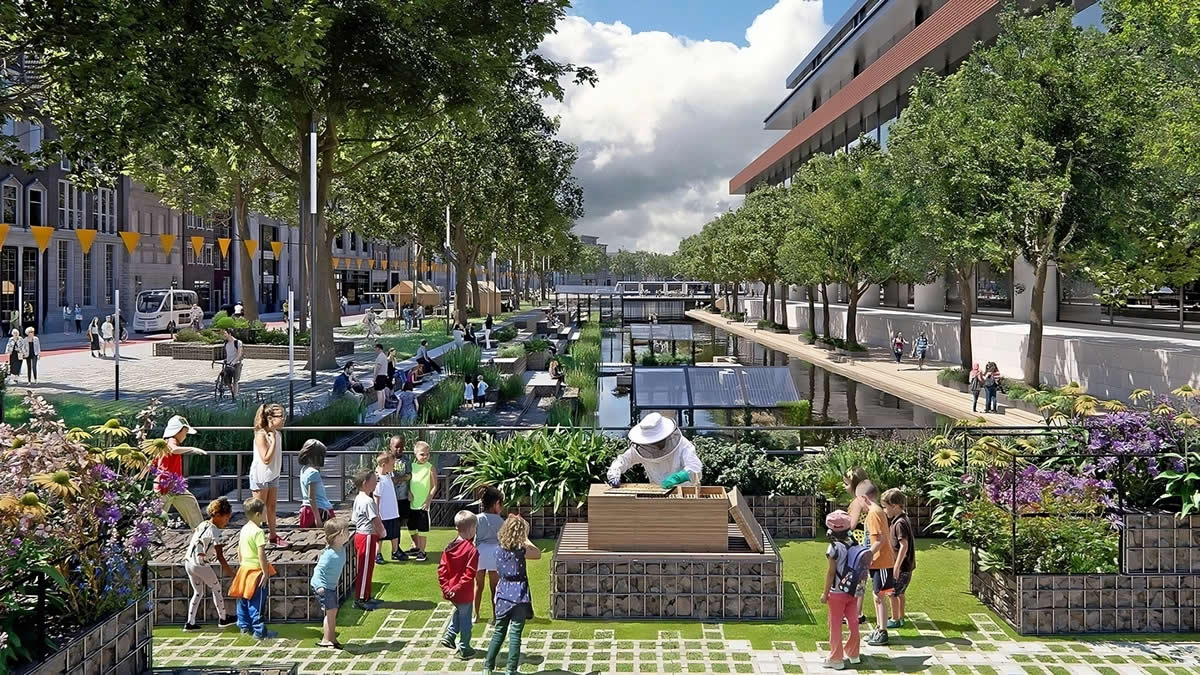
Here, the city experiments with green futures. The municipality runs Our Street Initiatives in this area, and residents turn paved gardens into green oases. In 2024, the free Tile Service collected eight thousand square metres of garden tiles from forty households, replacing concrete with greenery.
Wadis now collect rainwater, and more trees shade the streets. Climate adaptation meets everyday liveability here. Neighbours meet while planting, and conversation grows alongside the soil.
Between these two worlds sits Sarphatipark: green, historic, and intimate all at once.
From 1908 to 1911, the painter Piet Mondriaan lived and worked at Sarphatipark 42, at the edge of the park. His atelier there still belonged to his early, traditional style, before his work evolved toward the abstraction and primary colours the world later came to know.
The park itself carries the name of Samuel Sarphati, a physician and urban planner who believed cities should heal people. That belief still shapes the park today, in every bench, path, and tree.
Today, RYB Global Development and Culture of Peace NL work near this same corner, asking a related question: can a city heal through creativity? We believe it can.
Amsterdam’s Boost je Buurt programme supports neighbourhood changemakers directly. In 2025, twenty-seven local initiatives received coaching and funding, some in De Pijp and some nearby. All of them prove the same point: change starts with citizens.
Community gardens grow here, language cafés open their doors, and food waste initiatives help feed families. These are not government projects. They are neighbour projects.
These neighbourhoods hold many layers, so here is where to peel them back.
Discover the history of De Pijp and Rivierenbuurt. Visit Sarphatipark, where Mondriaan lived before his style evolved further. Explore Stadsdeel Zuid.
De Pijp will keep its colour, and Rivierenbuurt will keep its calm. Together, they will keep building.
New galleries will open, new gardens will grow, and new faces will arrive. The market will keep trading, and the park will keep breathing.
You already belong here. Walk these streets, feel the cobblestones, taste the market, and listen to what the city has to say.